Introduction: The Agentic Shift in Digital Labor
The trajectory of artificial intelligence has historically been defined by a progression from static retrieval to dynamic generation, and finally, to autonomous action. If the years 2023 and 2024 were characterized by the explosion of Generative AI—systems capable of producing text and imagery upon explicit human command—the era of 2025 and 2026 has been undeniably defined by the rise of Agentic AI. This represents a fundamental evolution in the relationship between human intent and machine execution. In this new paradigm, artificial intelligence ceases to be merely a passive tool waiting for a prompt; it transforms into an active worker, capable of receiving a high-level objective, formulating a strategic plan, executing a sequence of tasks, critiquing its own performance, and iterating until the goal is achieved.
At the forefront of this revolution—specifically in the democratization of access to autonomous systems—stands AgentGPT. Developed by Reworkd AI, AgentGPT emerged as a pivotal platform that bridged the chasm between complex, command-line-driven autonomous protocols and the accessibility requirements of the general public. By packaging the sophisticated recursive loops of autonomous agents into a sleek, browser-based interface, Reworkd AI fundamentally altered the landscape of productivity tools, allowing users to deploy autonomous agents without writing a single line of code.
For the modern enterprise and the individual professional alike, understanding AgentGPT is no longer a matter of technical curiosity but of strategic necessity. As organizations scramble to integrate AI labor into their workflows, tools that offer “Goal-Driven” autonomy are becoming the new operating system for productivity. This comprehensive report, commissioned for the readers of NeonRev, explores the ecosystem of AgentGPT in exhaustive detail. We will dissect its architectural underpinnings, its operational mechanics, its comparative standing against industry giants like AutoGPT and emerging frameworks like CrewAI, and its practical applications across diverse sectors.
Explore the full capabilities and tools profile of AgentGPT on our dedicated agent page: NeonRev AgentGPT Profile
Part I: The Genesis and Philosophy of AgentGPT
1.1 The Problem of Orchestration in Large Language Models
To fully appreciate the architectural innovation of AgentGPT, one must first confront the inherent limitations of standard Large Language Models (LLMs) such as GPT-3.5 or GPT-4 in their raw, conversational forms. Standard LLMs operate on a stateless, query-response mechanism. When a user interacts with a model like ChatGPT, the interaction is fundamentally synchronous and dependent on human orchestration. If a complex objective requires ten distinct steps—for instance, “Plan a corporate retreat”—the human user is forced to act as the “manager,” prompting the model sequentially for each sub-task: first asking for location ideas, then for venue pricing, then for catering options, and finally for a consolidated itinerary.
This friction is known as the “Orchestration Gap.” It places the cognitive load of planning, sequencing, and context management squarely on the human user. AgentGPT was engineered to remove the human from this orchestration loop.
An autonomous agent, as exemplified by the AgentGPT platform, operates on a Goal-Driven architecture rather than a prompt-driven one. The user provides a single, high-level objective—such as “Plan a detailed 7-day trip to Hawaii” or “Research the current state of generative AI in education”. The agent then assumes the role of the orchestrator. It decomposes the high-level goal into a prioritized list of manageable sub-tasks, executes them sequentially, stores the results in a specialized memory system, and evaluates its own progress. This recursive loop—Think, Plan, Execute, Critique—is the defining characteristic of AgentGPT, transforming the AI from a passive encyclopedia into an active teammate capable of multi-step problem solving.
1.2 Reworkd AI and the Democratization of Autonomy
The origins of AgentGPT are rooted in a desire to solve the accessibility crisis that plagued the early autonomous agent movement. When the concept of autonomous loops first gained traction with the release of AutoGPT, the technology was powerful but deeply inaccessible to the non-technical majority. AutoGPT required users to navigate complex installation procedures involving Python environments, dependency management, Docker containers, and terminal commands. This created a significant barrier to entry, effectively gating the power of autonomous AI behind a wall of technical expertise.
Reworkd’s solution was to build a web-native platform that abstracted this entire complexity away from the end-user. Utilizing a modern tech stack built on Next.js for the frontend and FastAPI for the backend, they created an environment where deploying an autonomous agent was as simple as visiting a website. This “browser-based” approach allowed for immediate access via agentgpt.reworkd.ai, removing the need for local software installation and configuration.
The project quickly resonated with the global developer community, amassing over 35,000 stars on GitHub and spawning thousands of forks, cementing its status as one of the premier examples of open-source innovation in the AI space. By 2026, the project had matured significantly, evolving through multiple beta versions to become a mature, stable reference implementation—a “classic” in the AI agent canon that continues to power thousands of daily workflows.
1.3 Core Value Proposition for the Modern User
For the NeonRev audience, the primary value proposition of AgentGPT lies in the intersection of accessibility and automation. The platform offers a unique set of capabilities that distinguish it from both standard chatbots and complex developer tools.
- No-Code Interface: Unlike its predecessors, AgentGPT requires absolutely no coding knowledge for basic operation. If a user can articulate a goal in natural language, they can deploy a sophisticated AI agent.
- Ephemeral & Long-Term Memory: Through integrations with vector databases such as Weaviate, the platform allows agents to retain context over long task chains. This addresses the “amnesia” problem inherent in standard LLM sessions.
- Cloud-Native Deployment: Users can access their agents from any device with a browser—be it a Windows workstation, a MacBook, or a Chromebook—without worrying about hardware constraints.
Part II: Technical Architecture and Operational Mechanics
2.1 The Recursive Loop: The Cognitive Engine
The “magic” of AgentGPT is not located within the Large Language Model itself—which is typically OpenAI’s GPT-3.5 or GPT-4—but rather in the recursive control loop that manages the model’s interactions. Understanding this loop is essential for grasping how AgentGPT achieves autonomy.
When a user initiates an agent by defining a name and a goal, the system triggers a sophisticated chain of events known as the “Agent Loop”:
- Goal Initialization: The system receives the input parameters (e.g., Agent Name: “MarketScout”, Goal: “Analyze the competitive landscape for AI coffee machines in 2026”).
- Task Generation (The Planner): The system prompts the LLM to determine the necessary steps to achieve the goal. The LLM returns a structured list of initial tasks.
- Task Execution (The Doer): The agent selects the first task and executes it. This execution might involve a pure LLM query or a call to an external tool like a search engine API.
- Context Storage (The Memory): The result of the execution is stored in the agent’s vector memory.
- Task Prioritization and Update (The Manager): The agent reviews the remaining tasks and the result of the just-completed task to decide if new tasks are needed or if priorities should change.
This cycle repeats until the task list is empty or a pre-defined loop limit is reached.
2.2 Memory Systems: The Role of Vector Databases
A critical differentiator for AgentGPT is its sophisticated handling of memory. AgentGPT utilizes Vector Databases to transcend the limitations of standard context windows. The mechanism relies on the concept of “embeddings.” When the agent learns a fact, the system converts this text into a high-dimensional mathematical vector.
Later in the workflow, if the agent needs to recall specific data, it queries the database for vectors that are mathematically similar to the concept at hand. This process, often referred to as Retrieval-Augmented Generation (RAG), effectively gives the agent “infinite” long-term memory, allowing it to stay focused and coherent even during complex, multi-day tasks.
2.3 The Tech Stack: Under the Hood
For the technical audience and developers visiting NeonRev, understanding the underlying stack is crucial for evaluating the tool’s robustness.
- Frontend: Built with Next.js, ensuring a highly responsive user interface. Styling is handled by TailwindCSS.
- Backend: Powered by FastAPI, a modern, high-performance web framework for building APIs with Python.
- Data Persistence: Uses Prisma (ORM) and MySQL for user data, and Weaviate for vector memory.
- Orchestration: Leverages LangChain, a prominent library for building applications with LLMs, serving as the connective tissue that holds the agent’s cognitive architecture together.
Part III: Detailed Feature Analysis and User Experience
3.1 The User Interface (UI): Design for Action
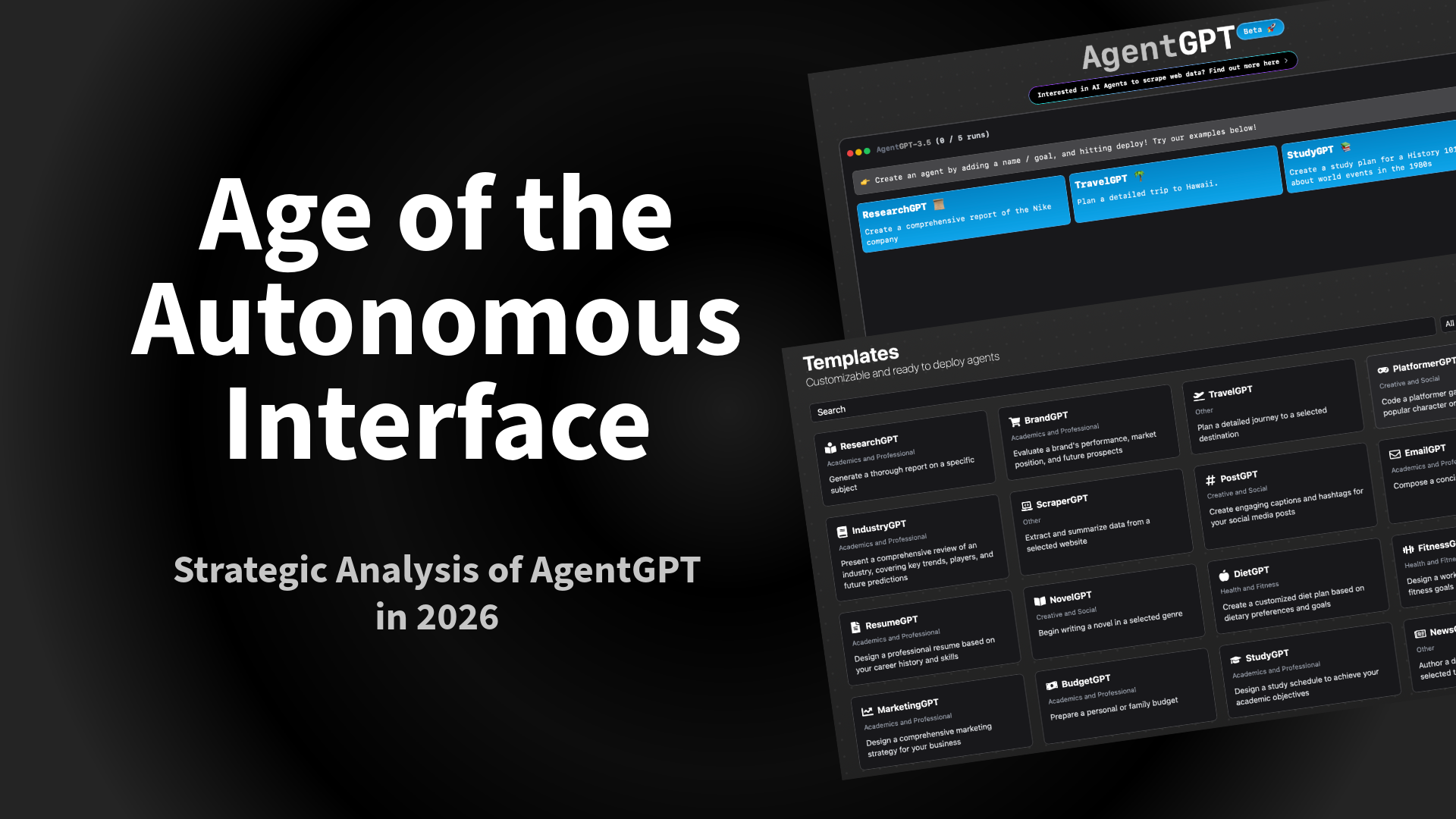
The User Interface of AgentGPT is a masterclass in functional minimalism. The Hero Section dominates the screen, presenting simple input fields for “Agent Name” and “Goal.” This emphasizes execution over conversation. To the right, a “terminal-like” window serves as the command center, displaying the agent’s internal monologue in real-time. This “glass box” transparency is vital for building trust in the AI’s actions.
3.2 Browsing and Web Search: Breaking the Knowledge Cutoff
One of the most significant features unlocked in the Pro plan is Web Browsing Capability. Without web access, an LLM is essentially a closed system. With web access enabled, AgentGPT utilizes a headless browser or a search API (such as Google Custom Search or Serper) to fetch real-time data from the internet. This capability transforms AgentGPT from a creative writing tool into a powerful engine for market research and real-time planning.
3.3 Export and Integration Ecosystem
AgentGPT functions as a node in a larger productivity ecosystem. It offers robust export features:
- Copy to Clipboard: Instantly move generated plans to docs.
- Image Export: Save workflow diagrams or logs as PNGs.
- PDF Export: Generate clean, readable reports.
- API Access: Developers can access the backend programmatically to build custom integrations (e.g., Slack bots).
3.4 Customization and Granular Settings
Users have granular control over the agent’s behavior:
- Model Selection: Switch between GPT-3.5 Turbo (fast/cheap) and GPT-4 (smart/reasoning).
- Loop Limit: Set a maximum number of loops to prevent runaway agents and budget drains.
- Multiple Languages: Truly global support for planning and research in various languages.
Part IV: Practical Use Cases and Strategic Applications
4.1 Market Research and Competitive Analysis
Scenario: A startup founder needs to understand the competitive landscape for “AI-powered coffee machines.” Agent Workflow: The agent decomposes the goal, searches for brands like “BrewBot” and “SmartSip,” analyzes pricing, synthesizes customer sentiment from Reddit, and aggregates data into a structured table. Why it Works: It automates the tedious “tab-switching” behavior of human researchers, saving hours of manual labor.
4.2 Content Generation and SEO Strategy
Scenario: An SEO Manager at NeonRev needs a content strategy for “The Future of SEO in 2026.” Agent Workflow:The agent queries industry trends, performs keyword research for terms like “AI Search Visibility,” structures a blog outline with headers, and cites sources. Insight: AgentGPT is often most powerful at the strategy and outlining phase, ensuring content is based on relevant research rather than generic training data.
4.3 Technical Scaffolding and Coding
Scenario: A developer needs to build a clone of a legacy intelligence dashboard. Agent Workflow: The agent breaks down the UI into components (Sidebar, SearchPanel), writes boilerplate React code, and generates Tailwind CSS classes for the layout. Limitation: AgentGPT is an architect, not a debugger. It is excellent for scaffolding but may struggle with complex codebase maintenance compared to specialized tools like Devin.
4.4 Travel and Personal Planning
Scenario: Planning a 10-day honeymoon in Japan (Anime + Shrines) on a $5000 budget. Agent Workflow: The agent researches logistics, finds hotels in Shinjuku, checks Shinkansen prices, and constructs a day-by-day itinerary logically grouped by location.
Part V: Comparative Market Analysis
5.1 AgentGPT vs. AutoGPT
- AgentGPT: Web-based, No-Code, Instant setup. Best for general research and planning.
- AutoGPT: CLI/Terminal based, requires Docker/Python. Best for developers needing local file system access.
- Verdict: AgentGPT is the superior choice for usability; AutoGPT is for technical power users.
5.2 AgentGPT vs. CrewAI
- AgentGPT: Single recursive agent working on a task list.
- CrewAI: Multi-agent orchestration (teams of agents with specific roles).
- Verdict: Use CrewAI for complex production lines; use AgentGPT for single-objective speed.
5.3 AgentGPT vs. Devin
- Devin: Highly specialized “AI Software Engineer” with integrated dev environment.
- AgentGPT: Generalist planner.
- Verdict: Devin is superior for pure coding; AgentGPT is more affordable and versatile for non-coding tasks.
Part VI: The Economics of Automation
- Free Tier: $0/month. Good for testing with GPT-3.5. Limited loops and web search.
- Pro Plan: ~$40/month. Access to GPT-4, unlimited web search, higher loop limits. Essential for professional use to reduce hallucinations.
- Enterprise: Custom pricing for SSO and team management.
Part VII: The Future of AgentGPT and the 2026 Landscape
As of early 2026, the AgentGPT repository on GitHub has been archived, signaling two things: maturity and a strategic pivot. The code is stable and serves as a “classic” reference. Reworkd AI is now shifting focus toward Large Action Models (LAMs)—agents that don’t just plan, but take action on websites (e.g., booking the flight, not just finding it).
For NeonRev users, this means AgentGPT remains a robust tool for research and planning. However, the future lies in Agent Optimization (AIO), where your brand must be optimized to be found by agents searching the web, not just humans.
Ready to deploy your first autonomous agent? Discover more about AgentGPT and start your automation journey by visiting our dedicated tool profile: AgentGPT on NeonRev
Appendix: Troubleshooting Common Issues
- Loop Limit Reached: Task is too complex. Upgrade to Pro or break down the goal.
- Hallucinations: Enable Web Search (Pro) and explicitly ask the agent to “Verify facts.”
- Repetitive Tasks: Stop the agent and restart with stricter constraints (e.g., “Do not check the same site twice”). Switch to GPT-4 for better logic.
Leave a Reply